


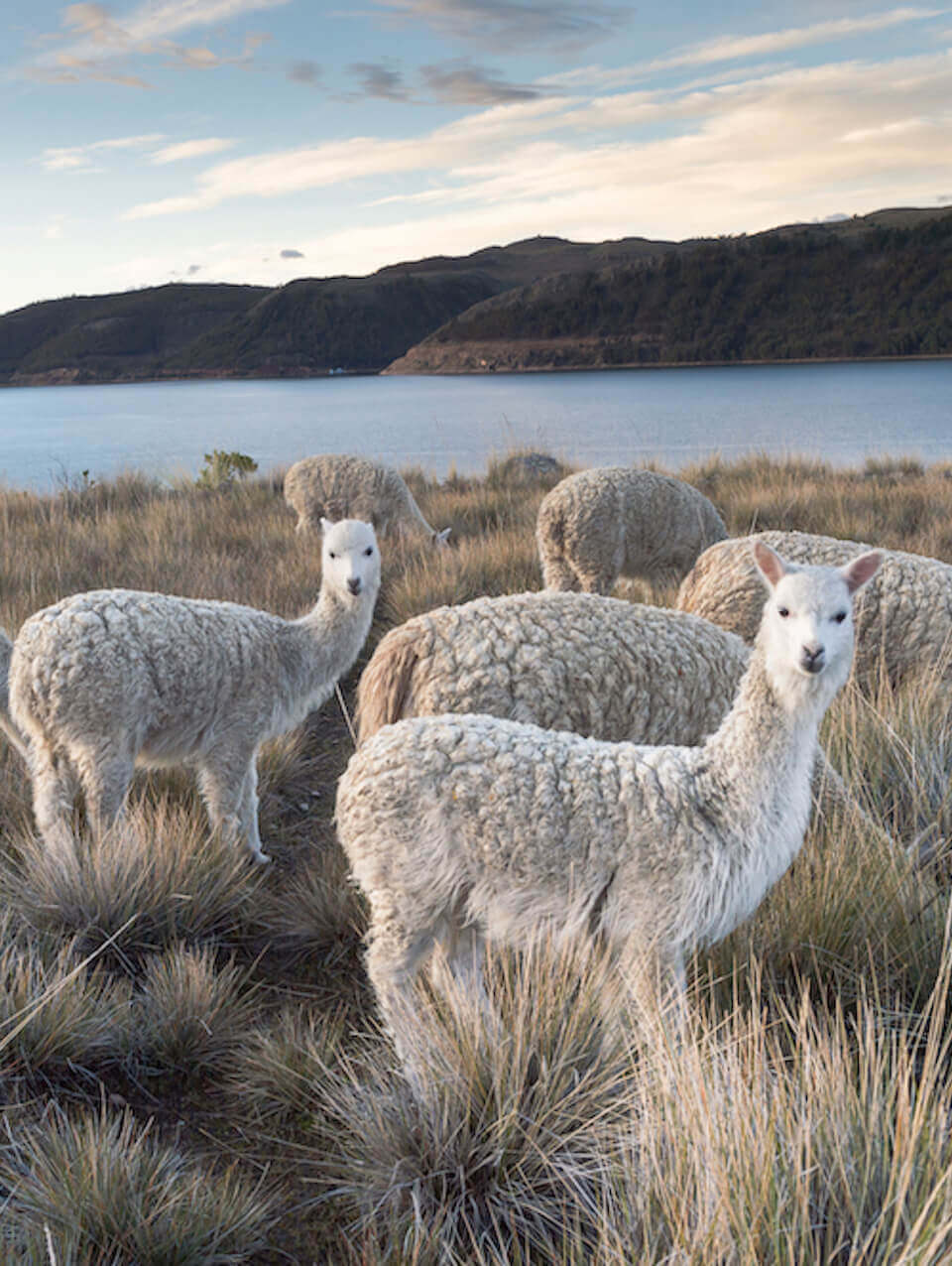
In terms of quality, it is surpassed only by cashmere (the wool of cashmere goats) and vicuña fibre, obtained from a wild Andean mammal considered the ancestor of domesticated alpacas.
Where do alpacas come from?
Charming and gentle, alpacas originate from South America. They are even-toed ungulates from the camelid family. Related to the vicuña, llama and guanaco, the alpaca is a rare and valuable animal domesticated around 6,000 years ago, perfectly adapted to the harsh Andean climate. To survive freezing winters and hot summers, alpacas developed soft, dense fleece with exceptional thermoregulatory properties, protecting them from extreme temperature changes all year round.
Alpaca fibre – a brief profile
Alpaca fibre is six times warmer than sheep’s wool and three times as durable. It breathes and adapts to body temperature — cooling when it’s warm and warming when it’s cold. It does not retain moisture; instead, it absorbs it from the body and dries quickly, keeping a pleasant feeling of dryness. It is hypoallergenic, contains no lanolin (wool grease), and does not require chemical washing agents like sheep’s wool does.
The properties of alpaca bedding
Duvets, pillows and mattress toppers filled with alpaca fibre have unique qualities that greatly enhance sleep comfort:
Bedding, night sweats and thermoregulation
As we know, one of the most important factors for restful sleep is maintaining the right body temperature — not too cold, yet not overheated. Thermoregulation is closely linked to sleep quality; overheating the body leads to lighter, disrupted sleep cycles.
Night sweats indicate that the body is struggling to regulate temperature properly. We all perspire, and mild sweating at night is entirely natural. What is not physiological, however, is excessive sweating — either during the day or in the form of night sweats. We lose about 25 ml of water per hour while sleeping — around 200 ml over eight hours. Most of this water is released through breathing or evaporates from the scalp, but some of it seeps into the bedding as perspiration. If this moisture is not effectively drawn away into the duvet or mattress, we wake up in damp bedding and pyjamas — a discomfort that makes our sleep shallower and less restorative.
As mentioned earlier, alpaca fibre naturally absorbs moisture from the body and releases it outward, drying quickly and creating a sensation of “dry warmth".
Why choose an alpaca duvet?
Since thermoregulation and moisture control are key to deep, uninterrupted sleep, it’s worth choosing a duvet suited to your individual sense of warmth and the temperature of your bedroom. In modern, well-insulated homes, a year-round duvet is often sufficient through autumn and winter — you can always layer a throw or blanket on cooler nights. In spring and summer, a light summer duvet is ideal. Those who feel the cold easily, have circulation issues, or prefer sleeping in cooler rooms with an open window, even in winter, may benefit from a warmer winter duvet.
At MyAlpaca, we craft duvets filled with alpaca fibre that adapt to body temperature and do not retain moisture — keeping you comfortably dry throughout the night. They are also hypoallergenic, recommended by the Polish Society of Allergology for allergy and asthma sufferers.
[pw-products=35,37,36,32]
The properties of an alpaca pillow
A pillow filled with alpaca fibre is natural and breathable. It absorbs moisture from the head and dries quickly, so you won’t perspire while sleeping. Again, we return to the topic of night sweats: most water is lost through the head, and if a pillow doesn’t breathe or wick moisture away, your head and hair will feel damp. This discomfort affects the depth and quality of your sleep.
An alpaca pillow is firmer than a down one, providing excellent support for the cervical spine — and it’s also an ideal choice for allergy sufferers.
[pw-products=153,152,154]
Which mattress should you choose?
We recommend a mattress with natural filling — one that breathes and allows moisture to evaporate. It’s also worth protecting it from stains and wear with a mattress protector. Not a waterproof one, as breathability is key, but one that complements the mattress’s natural ventilation. We offer mattress protectors filled with alpaca fibre — breathable, moisture-wicking, and machine washable at low temperatures.
[pw-products=30,31]
Which bed linen is best?
We recommend natural linen, sateen or cotton bedding with a sateen or percale weave. Colours and patterns, of course, are a matter of personal taste.
MyAlpaca offers plain linen bedding, plain cotton percale bedding, and cotton sateen bedding printed with our unique Toile de MyAlpaca pattern.
[pw-products=147,70,138]
We wish you sweet dreams — naturally.

