

 Which MyAlpaca duvet is best for me?
What makes a good duvet?
A good duvet regulates your body temperature while you sleep.
Our body needs protection against both heat loss and overheating at night, as its temperature changes while we sleep. Poor thermoregulation can seriously disrupt sleep. In the evening, body temperature drops, signalling the brain that it’s time to rest. The initial cooling feels pleasant, but as the night goes on, without the right duvet we may simply get cold and wake up. The same happens if we get too warm. A good duvet retains the body’s warmth through the night or releases excess heat, maintaining a balanced temperature for deep, restful sleep.
You won’t sweat under a good duvet.
Moderate perspiration at night is completely natural. Excessive sweating, however, means the body struggles to regulate its temperature and is overheating. A good duvet will not only prevent overheating — it will also wick away excess moisture from the body.
Under a good duvet, you sleep more deeply and wake up truly rested.
Our sleep consists of cycles, each made up of light and deep phases. To improve sleep quality, we should aim to extend the deep-sleep phase — when the body regenerates most effectively. During REM sleep, when we dream, the body cannot regulate its temperature. It’s a light stage of sleep, and we wake easily from being too hot or too cold. If it’s too warm, the REM phase becomes shorter, and the following stages shallower. A good duvet helps regulate temperature properly, promoting deeper sleep — so you wake up feeling refreshed.
The gentle weight of a duvet can calm the mind.
Experts say that being cocooned under a duvet of the right weight can reduce stress and anxiety. Gentle pressure stimulates the production of serotonin — the “happiness hormone” — which also helps regulate sleep.
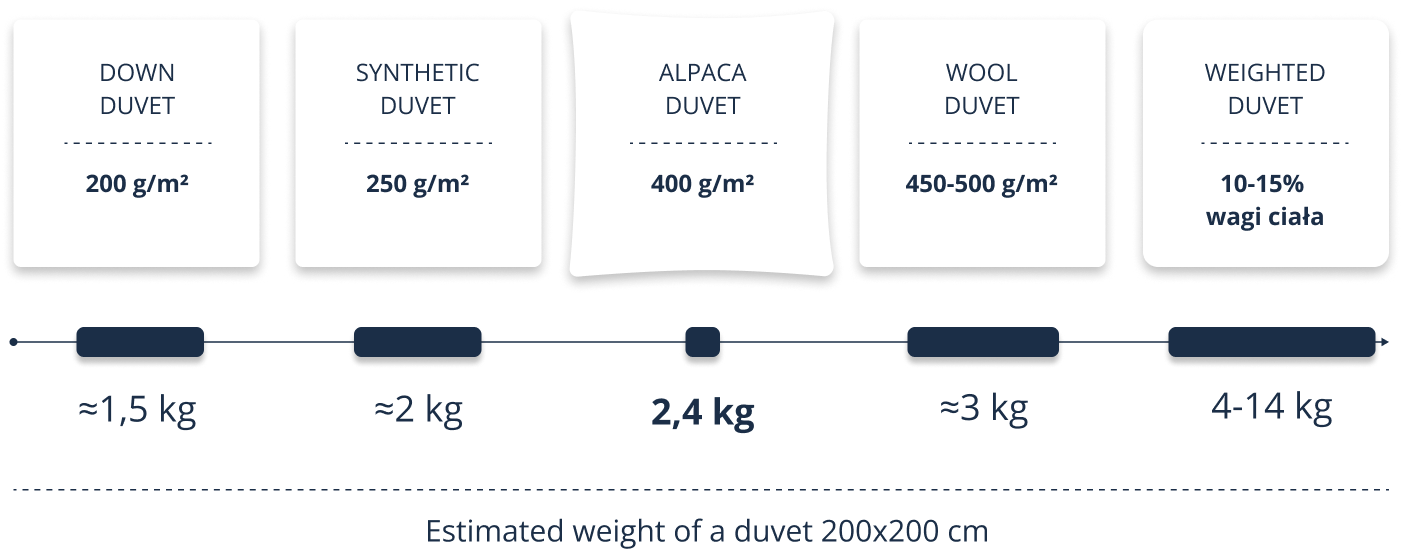
An alpaca duvet has an optimal weight: heavier than down, pleasantly enveloping, yet lighter than wool or weighted duvets.
No fibre regulates body temperature better than alpaca fibre.
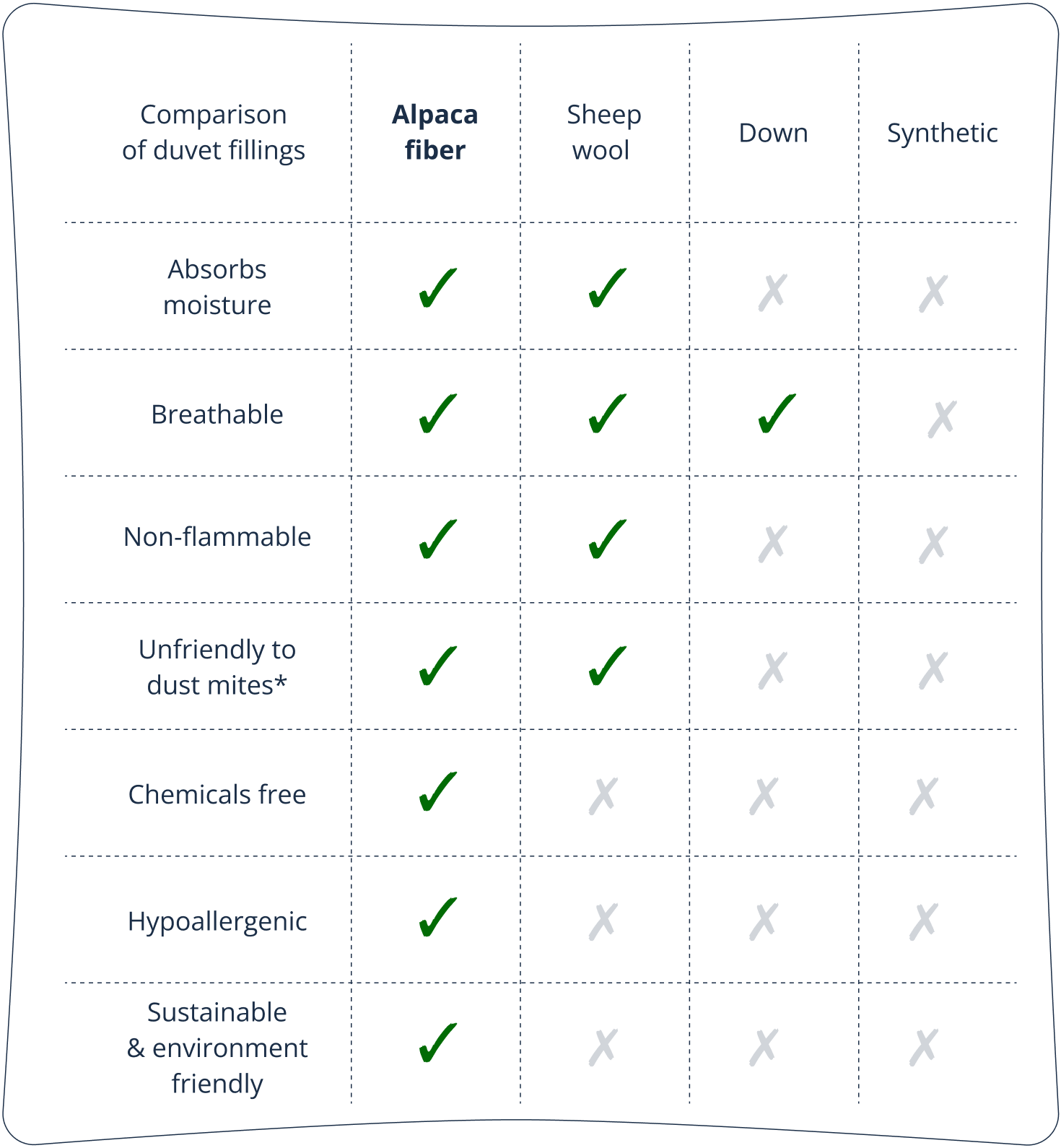
Alpaca wool achieves a perfect balance of thermal properties. Its remarkable performance comes from the microscopic structure of the fibres — hollow inside, with tiny air channels that provide natural thermoregulation. This unique structure insulates warmth while allowing air to circulate, adapting to changes in both body and ambient temperature. As a result, alpaca wool maintains a stable microclimate, preventing both overheating and cooling.
Hypoallergenic and kind to the skin.
With allergies and sensitivities more common than ever, the choice of natural, skin-friendly materials is increasingly important. Alpaca wool contains no lanolin, does not irritate the skin, and its properties make it inhospitable to dust mites. MyAlpaca duvets are tested and recommended by the Polish Society of Allergology for people with allergies and asthma.
Duvet filling
Alpaca fibre is among the most luxurious natural fibres in the world. Soft to the touch like cashmere, yet stronger and lighter than sheep’s wool — and cosier than down.
Alpacas have perfectly adapted to the harsh Andean climate. To survive freezing winters and scorching summers, they developed dense, soft fleece with thermoregulatory properties that protect them year-round.
Alpaca fibre is six times warmer than sheep’s wool and three times more durable.
It breathes, adapting to body temperature — keeping you cool when it’s warm, and warm when it’s cool.
We source our fibre responsibly from verified European farms. For duvets and pillows, we use only white fibre, ensuring that darker strands don’t show through the tightly woven, lightweight cotton casing. For duvets and pillows, we use only white fibre, ensuring that darker strands don’t show through the tightly woven, lightweight cotton casing.
We oversee the entire process of preparation. The fibre is washed with mild, allergen-tested agents certified by the Polish Society of Allergology. Alpaca wool is also biodegradable, giving it one of the lowest carbon footprints among all filling materials.
In our own workshop, we card the fibre ourselves, ensuring the perfect loft and weight for each type of duvet and pillow filling.
Choose the right fill weight.
When choosing your duvet, consider your local climate, bedroom temperature, and your personal sensitivity to heat and cold.
The ideal sleeping temperature is around 18°C. If your bedroom is much warmer or cooler, your sleep quality may be affected. Many of us have experienced sleepless nights during summer heatwaves, when even a sheet feels too warm. That’s why it’s important to match your duvet to the season, your bedroom temperature, and your individual thermal comfort. Some of us feel the cold easily and need a warmer duvet most of the year; others tend to feel hot and prefer a lighter one.
Many MyAlpaca customers choose our year-round duvets for their versatility. However, if you live where temperatures fluctuate, or you prefer to sleep more snugly or lightly, we also offer summer and winter duvets to suit your needs.
ALL SEASONS
Contains 400 g of alpaca wool per m² and is suitable for use throughout the year in European climates. Of course, during frosty nights some may add a blanket, and in the hottest summer nights simply use a sheet. Remember that everyone’s sense of warmth and comfort is individual — it depends on room temperature, sleepwear, and personal preference.
[pw-products=35,84,172,193,79]
SUMMER
Contains 200 g of alpaca wool per m². Ideal for spring and summer, or for those who tend to feel hot at night and wish to avoid overheating.
[pw-products=36,85,189,192,80]
WINTER
Contains 600 g of alpaca wool per m². Perfect for cold winters, especially for those who enjoy sleeping with the window open or who tend to feel chilly — for example, due to circulation issues. Also ideal for those who prefer to have two duvets — one for summer and one for winter.
[pw-products=37,190,81]
FOUR SEASONS SET
The perception of warmth and coolness is highly individual — and so is the temperature in every home.
[pw-products=38]
MyAlpaca duvets have small fabric loops sewn into the binding — one in each corner and one in the middle of every side. This allows the summer and year-round duvets to be tied together, creating a single winter duvet. An ideal solution for both warm and cold nights.
You can order two duvets together as a set, or purchase a summer duvet first and add a year-round one later in the season — they can easily be joined when the nights turn colder.
Many duvet brands use TOG ratings as a guide to overall thermal insulation. We believe this can be misleading when talking about the unique thermoregulatory properties of alpaca wool, so we classify our duvets by fill weight instead. However, for comparison, our summer duvet is roughly equivalent to 4 TOG, our year-round duvet to 8.5 TOG, and our winter duvet to 11 TOG.

