


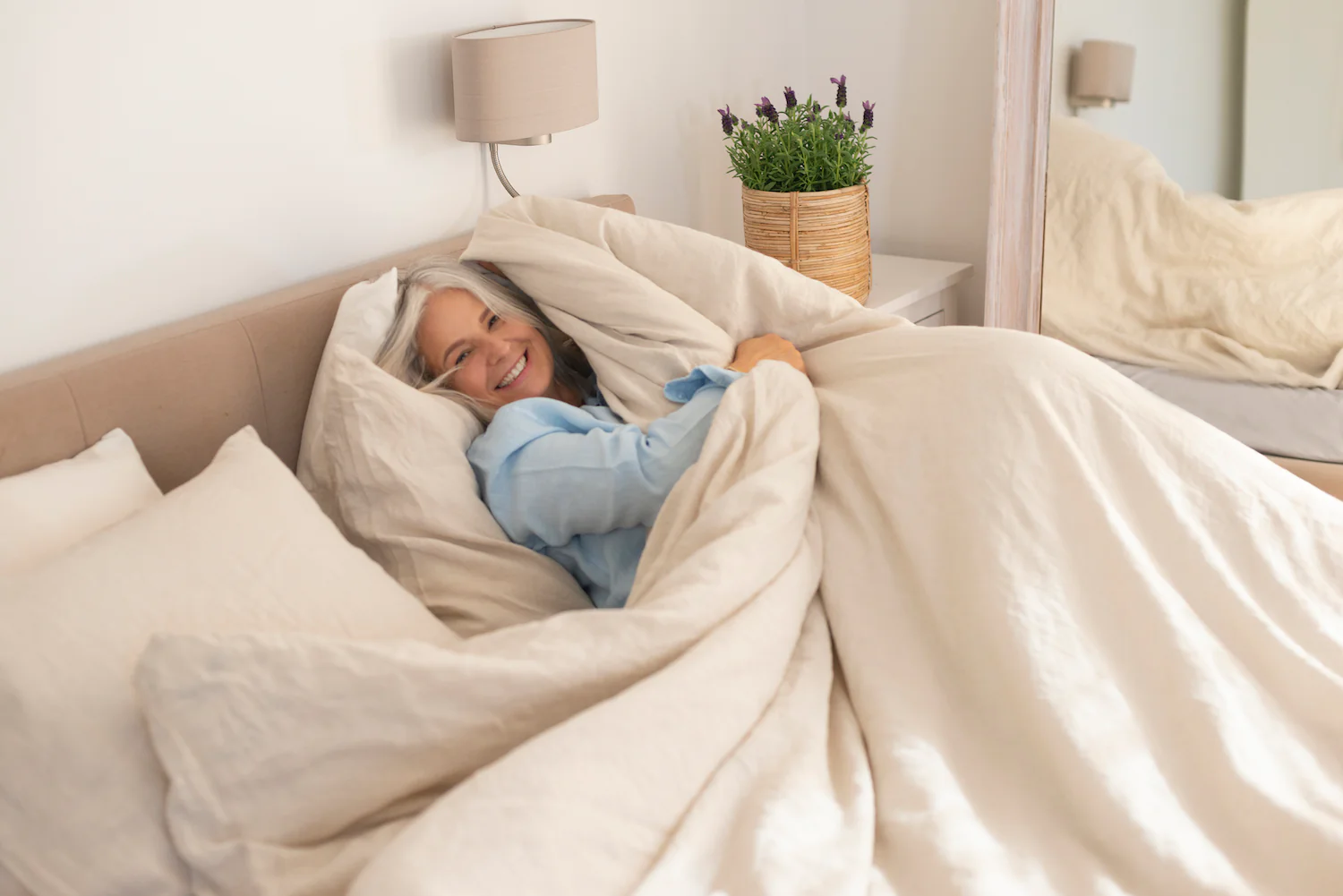
Allergies in the bedroom are an issue affecting an increasing number of people, including our children. What causes these reactions? Down? Wool? And why?
There are many allergens in our homes. Some come from chemicals used in the production of the textiles surrounding us. But in the bedroom, the main culprits are dust mites. These tiny, invisible arachnids hide in dust. While they pose no threat to humans, their droppings are a strong allergen for sensitive individuals. Most dust mites are found in beds, where they have ample food—shed human skin.
THE ALLERGY-FRIENDLY BEDROOM
If you are an allergy sufferer, your bedroom should be kept almost sterile.
Cozy rugs, velvet curtains, and soft armchairs should, unfortunately, be removed from your bedroom. They collect dust and are difficult to clean. For windows, use curtains that can be washed, and cover the floor with lacquered wood, parquet, or panels that can be wiped clean. Avoid keeping books and ornaments in the bedroom where dust can accumulate. Wipe surfaces with a damp cloth and consider investing in a vacuum cleaner with a high-quality air filter that captures almost 100% of dust and allergens, such as spores, dust mites, and pollen.
THE BED
Choosing a bed and mattress is very individual. Allergy sufferers are often recommended latex mattresses, as they do not collect dust. However, comfort is also important, so select a mattress that suits you. Every mattress should be protected with a cover, which should be washed regularly (at least once every two weeks at 60°C).
DUVETS AND PILLOWS
Dust mites love foam, polyester, and down. Most allergists advise against down pillows and duvets, as feathers and down can trigger allergies and are ideal habitats for dust mites.
This is why hypoallergenic bedding should be chosen.
DUVETS AND PILLOWS FILLED WITH SYNTHETIC FIBRES
There are many modern synthetic fibres used for bedding fillings, many of which are certified hypoallergenic, as they do not provide a suitable environment for dust mites.
A major advantage is their practicality—they can be washed frequently in a washing machine at 60°C.
The downside? Synthetic fibres are not very breathable, so you may overheat under a duvet filled with them or when resting your head on a pillow filled with them.
ALPACA FIBRE DUVETS

A natural alternative to synthetic fibres in bedding.
Alpaca fibre is hypoallergenic. Unlike sheep’s wool, it contains no lanolin and therefore does not require chemical treatment or additives during washing.
Alpaca fibre is washed only mild products to remove dust. Importantly, it does not retain moisture. Thanks to its hollow structure, it has thermoregulatory properties and creates a dry environment unfriendly to dust mites.
Therefore, alpaca fibre is ideal for people suffering from various allergies and asthma.
It may also be the best solution for those allergic to down or sheep’s wool. Lanolin, present in wool, can trigger allergic reactions. Many wool allergies are linked to chemicals and detergents used in wool processing.
MyAlpaca products have been tested by the Polish Society of Allergology and are recommended for allergy and asthma sufferers.

[pw-products=35,37,36,32]
BEDDING COVERS
The material of duvet covers, pillowcases, and sheets is also important. The best are natural cotton or linen, preferably white or light-coloured, which can be washed at higher temperatures (60°C). Regular changing of bedding (at least once a week) is recommended, using hypoallergenic detergents.

[pw-products=138,70,147]

